Sadler’s Wells, London.
20 May 2026.
Northern Ballet always brings unique stories to stage, and Gentleman Jack is no exception. From her first appearance, Nida Aydinoğlu dancing as Anne Lister, often dubbed ‘the first modern lesbian,’ was magnetically arresting, displaying the most astonishing level of sustained power and energy right through the production.
Although the story moved along rather slowly, particularly through Act I, and contained scenes that felt repetitive, such as men shunning Anne over and again, the production itself was very engaging. Choreographer Annabelle Lopez Ochoa gave Anne a stick which was used in various ways throughout the ballet, frequently as a method to give her confidence and status in the world of men that she tried to establish herself within. Through the choreography, I noted I did not really feel sympathy towards Anne, though she suffered at the hands of the men. She was given such a bold and self-sufficient way of moving and carrying herself, that belief in her was planted from the outset.
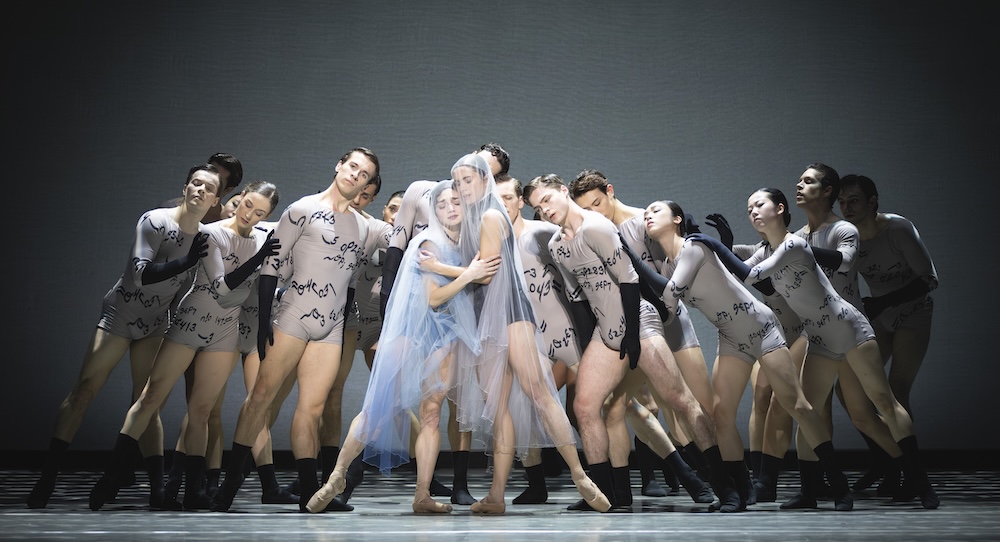
Moving units/bookcases were pushed on and off stage by dancers and used to reasonable effect to project scenery such as a woodland walk, or moving clouds. I enjoyed the body of dancers whose grey leotards contained snatches of words on them. They portrayed Anne’s writings and swarmed around her as she danced with a quill. And the servants in white corsets, who subtly assisted with many prop, costume and scenery moments.
There was a particularly tender rapport between Aydinoğlu and Sarah Chun, playing Anne’s initial love interest Mariana. They performed a sensual duet together, which was touching, though didn’t give (perhaps intentionally) the passion that is normally seen in bedroom scenes in other ballets. They did feel as though they belonged together, though, which was poignant as that is not how the story ended.
Anne’s visit to Paris at the beginning of Act II was brief, but colourful and joyous with loose haired dancers in flowing skirts. Anne felt seen as she connected with them; this scene could have been longer. This followed a very dark time for Anne which crossed the end of Act I and into Act II, when she was beaten and thrown to the ground by some of the men. This act was more dance than it was violent and maybe could have had added depth with some stage-fighting elements to it.
There were several light and comedic moments thread throughout the ballet and Anne’s meeting with Ann Walker – Julie Nunès – was certainly one of them. The women’s eyes met, their attraction and interest immediate. Ann reached continuously towards Anne but was physically moved away each time by her aunt and uncle, though her body language and eyeline remained with Anne. The audience enjoyed this section.
Their partnership seemed inevitable, though without the deep attraction Anne and Mariana had had. A particularly visually effective part was the wedding aisle created by the corps de ballet as Anne’s writings. They formed a channel widthways across the stage and Anne and Ann Walker, both on pointe now, travelled towards one another, both clothed in flowing veils. The veils did cause some minor entanglements, but this was a pretty and protective scene of connection.
We drew to a close with Anne’s signature music – a varied and captivating score by Peter Salem – she paced in coat, hat and stick on the central treadmill that had been brought on and off at different times. Turning to the audience, her final pose was framed as a huge gold-edged picture frame lowered from the flies and faded into blackout. A simple and innovative ending, and another powerful ballet in the repertoire for Northern Ballet.
By Louise Ryrie of Dance Informa.