Sadler’s Wells Theatre, London.
25 April 2026.
A performance review with a difference. I arrived to take part in a Touch Tour on stage with Birmingham Royal Ballet prior to the performance of Don Quixote. For visually impaired people, the Touch Tour strives to allow access and detail to the ballet by closeup inspection and explanation of the props and scenery used. We were greeted in the Sadler’s Wells foyer and introduced to various members of the organization team. As well as Birmingham Royal Ballet and Sadler’s Wells who were leading the event, there were representatives from a wide range of ballet companies in attendance — Matthew Bourne, Northern Ballet, Scottish Ballet, and English National Ballet — meeting together in a bid to make ballet more accessible to more people.
We were taken on to the stage, where props that were used throughout the production were laid out and willow branches flown in from the flies, so that it was possible to touch and imagine them. The enthusiastic voices of Kerry Elkins and Birmingham Royal Ballet’s Stage Manager described many of the props and invited people to feel them, explaining when, why and how they are used in the ballet. We were introduced to the barrel horse, which is built on stage and ridden by Don Quixote, played today by Principal Character Artist Jonathan Payn who was in attendance at the Touch Tour and very amenable to answering questions.
First Artist Roseanna Ely also joined us as we moved through to a meeting room. Seated in a circle, a range of costumes were brought round for us to touch and to listen to information such as which character they were worn by, and descriptions of the patterns on the material. Among others, we viewed one of Kitri’s friend’s dresses, and Kitri and Basillo’s wedding costumes. Sitting in a circle enabled members of the appreciative audience to ask costume-related questions. A buffet lunch was presented, and then it was time to collect a headset to listen to the live audio description of the ballet, by Kerry Elkins.
She had a very clear voice, and she provided some excellent detail on movement and partnerships, so that it was easy to imagine what was happening on stage, as well as mood and feeling; “He sweeps her high and parades her around to the admiration of the crowd…..” I found it a very different experience listening to description as well as watching the dancing; sometimes distracting, sometimes deepening my absorption. For those in attendance with visual impairment, I think it served as an excellent method to embrace all people into the onstage magic, alongside the rousing, expressive live music.
Don Quixote is a strange narrative ballet, performed in three Acts, with the title character Don Quixote – performed by Jonathan Payn – not actually being the main focus; his eccentric role more of a framework to the actual storyline, which features Kitri, who is in love with Basilio, though her father doesn’t approve. The ballet takes us through various pathways and scenarios, until Kitri’s father unwittingly blesses them in marriage, and (often unusually) there is a happy ending!
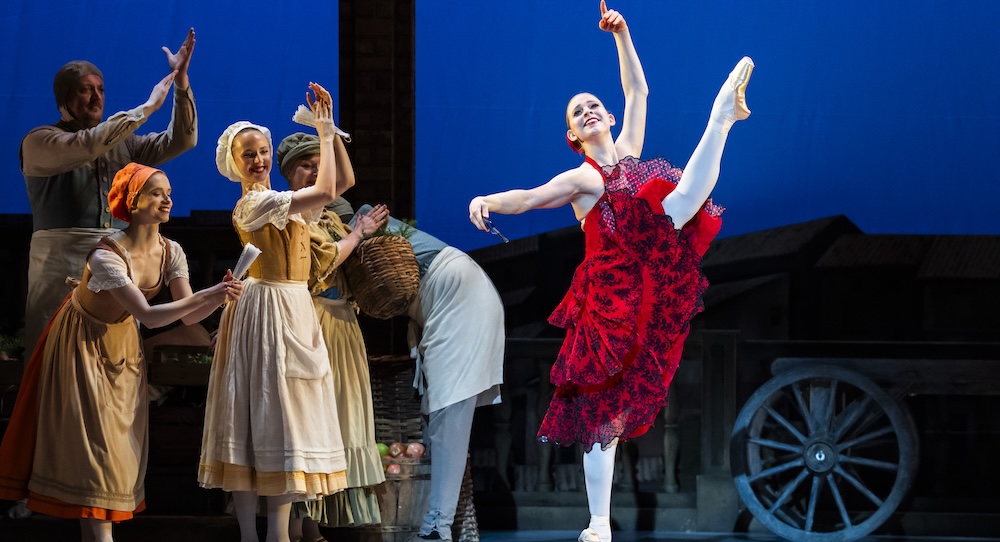
Yu Kurihara as Kitri, was divine, dressed in red and black, full of vivacious energy; she stole the stage whenever she was on it, her facial expressions and gestures as alive as her sparkling executions. She matched very well with her counterpart Enrique Bejarano Vidal who was idealistically charming and strong in this lively ballet, that had a continuous thread of attractive Spanish flavour throughout the choreography.
Reflecting back, the overall lasting impression is one of energy and busyness. The market scene of Act I was full of action in each corner of the stage, lots of little interactions to spot. Kitri’s friends had a lovely rapport between the two of them – this afternoon danced by Frieda Kadan and Yuki Suguira. Espada the matador (Max Maslen) and Mercedes (Yaoquin Shang) made a dynamic couple, plenty of humour here in their roles as Mercedes continually saw off competitors chasing after Espada.
Wandering away from the market, the forbidden lovers arrived in a gypsy camp in Act II where they were first threatened and then accepted by the gypsies. Oddly, Don Quixote also appeared in this scene and was enveloped into the group. Some passionate and eye-catching dance in this Act; the gypsy skirts worn by the women very effectively whirled like windmill sails, as they spun round in a lively group dance. A tender adage quartet between the chief gypsy couple and Kitri and Basilio, and an atmospheric moment with two live guitarists seated round the campfire while dancers swayed and socialised. This was a lovely moment that could have been extended.
A happy Act III concluded the ballet after other smaller subplots; beautiful flower arches across the back of the stage, bridesmaids in white tutus and flower headdresses and Kitri and Basilio in white and gold, framed in the centre by the gathering crowd. The music soared as once married they melted into a romantic duet.
Don Quixote climbed once more onto his barrel horse, Kitri was lifted to kiss him farewell and he exited leaving the rest of the crowd to enjoy the wedding party. The curtain fell as they laughed and drank together; a pleasing end rather than a formal end position.
By Louise Ryrie of Dance Informa.