Sadler’s Wells, London.
7 October 2026.
Carlos Acosta’s Acosta Danza presented a double bill, Cuban Baroque, curated by Acosta Danza, featuring Andonis Foniadakis’ Pearls and Goya Montero’s Chacona.
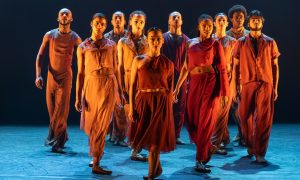
Pearls, a premiere by Andonis Foniadakis, opened with an atmospheric start – dancers walking across the back of the stage and towards the audience. A central dancer moved to the distinct baroque style score within a projected cube of light, its perimeters changing throughout. Lighting, in tones of pink and purple, complimented costuming well, with the moving projected lines framing the consistent evolving blend of movement as the work built.
Beautifully inventive costuming, by Anastasios Sofroniou; the attractive plum-coloured costumes reappeared with and without long skirts for the women, some of them with shorts and men with and without tops.
The choreography was very fluid and circular, picking up on inflections in the music – a live performance of Esteban Sallas’ Salve Regina, with the intention of showcasing the fusion between memory and contemporary. Male-female partnering was fast and fluid, showing pleasing rapport and innovation as they sailed in and out of the central performance area. The breaths in the music were pleasingly highlighted as well, sometimes illustrated by group freezeframes, lifting two female dancers overhead. I enjoyed the changing performance spaces, governed by the projected moving lines and the way that dancers melted in and out of the shadows at quite a rate. Pearls was a seamless work that held my attention from start to finish.
An hypnotic infusion of contemporary language within classical work, including elements of acro interwoven and a warm ambience on stage as we moved into the present; as though they’ve always belonged together. It was actually rather a beautiful piece to get lost in – their continual energy breathtaking.
The shift from baroque to present was pretty gradual and subtle; there was a reverberating hum, electronic sounds and a rapid picking up of pace from dancers embodying the intensifying Cuban beat. The work continued to build and perhaps just at the point when we wondered how they had capacity to keep going at such a continuous rate, a humorous collapse of the group of eight dancers proved they were human too!
Bringing the piece to an end, with a slow motioned exit.
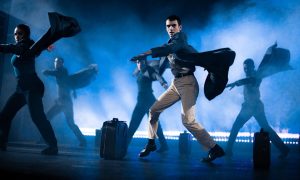
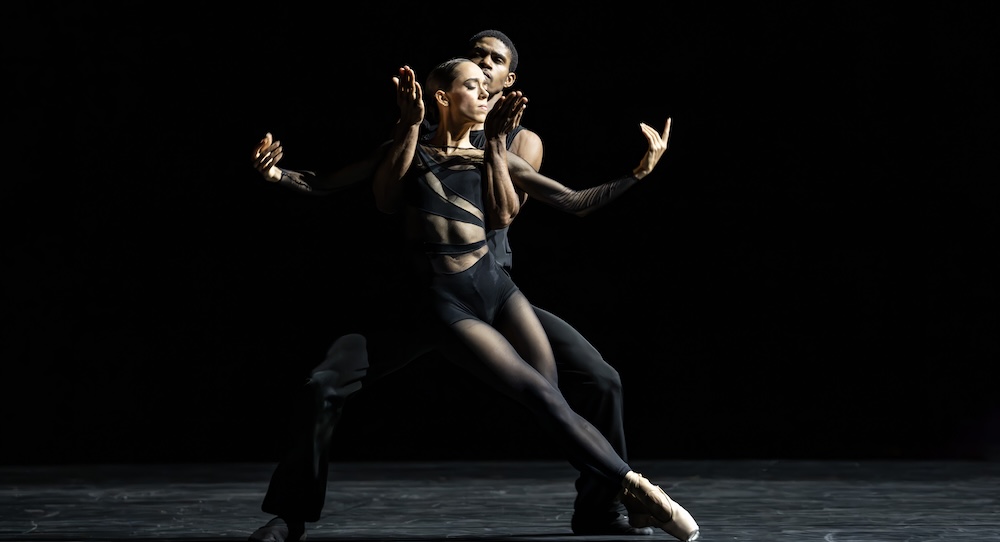
Act II brought Goya Montero’s Chacona, which opened with dancers in black in two vertical lines, either side of a projected column of light on the stage floor. The strongest element of this calm work was the connection of live musicians – Pepe Gavilondo, Ezo Sarici and Adrian Aguiar – on stage with the dancers; pianist centrally at the back, violinist downstage right and guitarist downstage left.
To a music score by Bach — Partita No.2 in D Minor –sometimes the movement did and sometimes it didn’t represent the running patterns and preciseness that Bach’s work requires. I sometimes wanted the often simplistic movement – lots of walking and standing – to match the complexities of the score, though I could still appreciate it as another’s interpretation of the music.
At times, it felt quite restful, though more light and shade was possible. Choreography had moments of looking unorganised, but some pleasing lifts as dancers placed themselves in exacting lines, and some eye-catching rippling movement travelling in canon along the line of dancers.
Lighting by Sammy Emmins was effective, playing a big part in shaping the dance work as a whole, particularly side lighting from the back corner reaching diagonally across the stage and dancers to the violinist in the opposite front corner. A chequerboard of light is another good example; dancers often in partnerships moved into the lit squares, and out again into the shadows. Shadows actually played quite a large role in Chacona. Lines of dancers stood continuously on the peripheral edges of the projected shapes of light on the stage floor – squares, rectangles, triangles. These changing shapes worked well to frame sections of the large stage.
Overall, an interesting though rather underwhelming work. Paired with Pearls this evening, perhaps it could have worked better in Act I. Incredibly talented dancers. An entertaining evening, just the right length.
By Louise Ryrie of Dance Informa.