Richmond Theatre, London.
22 and 23 April 2026.
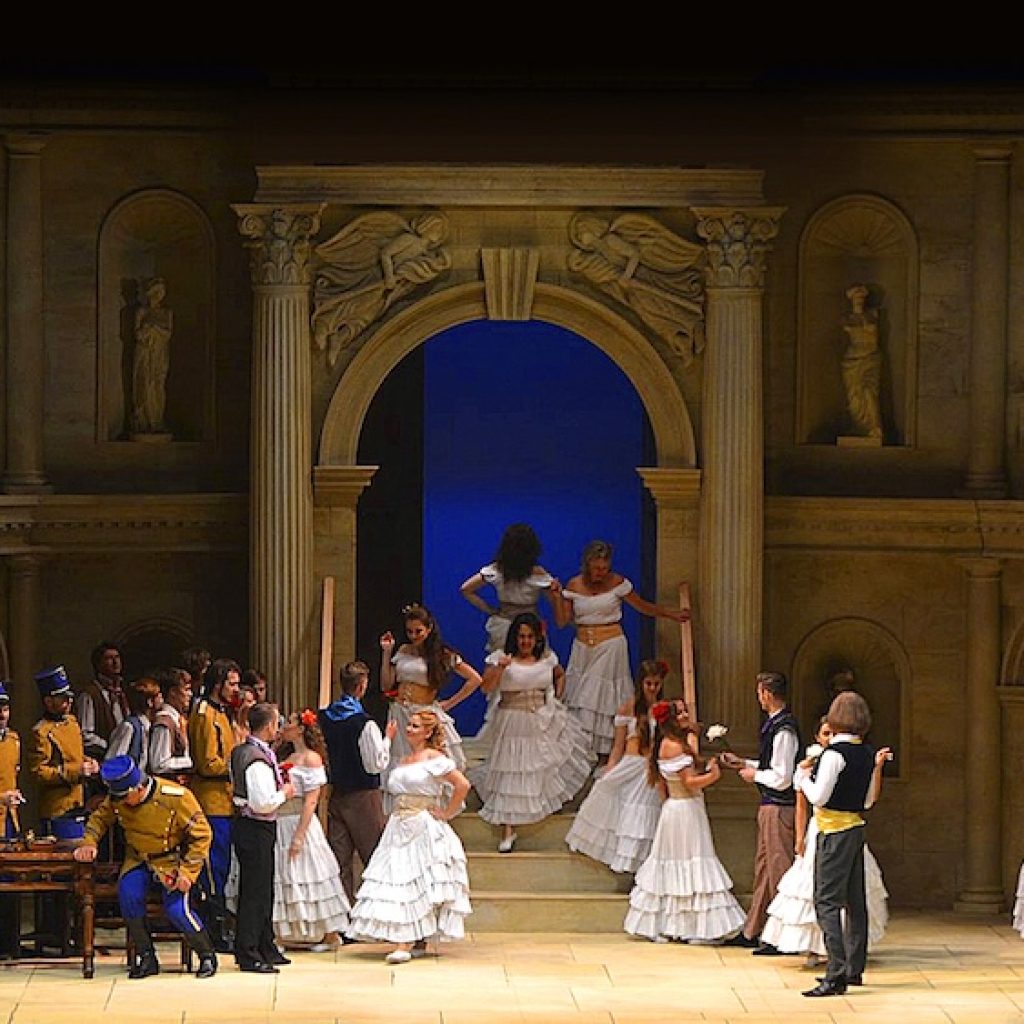
I’m so fortunate to be seated for two of Ellen Kent’s farewell tour performances with Senbla, very close to the orchestra. The curtain rises on the lengthy production of Carmen – four Acts done in three – a relaxed, ambient village scene; guards playing cards, meandering about the stage which led up to the changing of the guard. The scenery closed the stage in width wise, which made busy scenes look quite cramped. Sometimes the acting was a bit stilted, and there was not always authentic-looking chemistry between performers, as the singing took precedence here.
Women entered seductively, in tiered dresses, smoking, moving flirtatiously among the men with a nice Spanish flamenco element to their choreography. Carmen – played by Mariia Davydova, entered confidently, very convincing in her role, barefoot and happy to be distinctive from the others. She had a strong commanding voice to match and enjoyed the attention of the men. There was pleasing rhythmical movement from the women’s chorus too. Carmen’s energy monopolised both the men and women and she selected her chosen man Don José – Hovhannes Andreasyan – by throwing a flower at him, laughing and closing the door in his face when he followed her. She even struck a deal with him on her way to prison for having assaulted another woman. Her seductive energy was fun to watch, and Don José finally showed what he was capable of vocally as he asked Carmen to marry him.
In the tavern, Carmen now engaged, wore a glittering black and red lace dress. Sultry red lighting was effective, and females danced with fans and scarves, while men sat around drinking from tankards. Escamillo, the bull-fighter entered, and delivered Bizet’s memorable and familiar solo standing on top of the central table. Carmen fixed him with her gaze, and we knew what would happen next. Jumping ahead two months to Don José’s release from jail where he was serving time for allowing Carmen to escape; she tormented him, when the bugle called him back to barracks, she pressed him to stay with her. His anger built, but at the depth of it was love; “The flower you gave me stayed with me in jail,” he sang, pouring his heart out in this yearning song.
Act II and III developed Carmen’s coercive controlling nature more; she continued to dominate Don José, with her eyeline, confident smirk and sashaying walk. I enjoyed the tarot card scene where two of the other women dealt cards, singing a bright and breezy duet, revealing highlights in their futures, but when Carmen joined in, she dealt death. Don José became more violent with her – he slapped her and squeezed her neck in some realistic and revealing moments.
What I noticed about both operas, was the unhurried unfolding of the storylines, as opposed to faster paced modern theatrical productions, keen to keep their audience’s attention. Carmen’s final scene saw her defiant, but scared, as Don José approached her; an offstage chorus singing as he plunged the dagger into her.
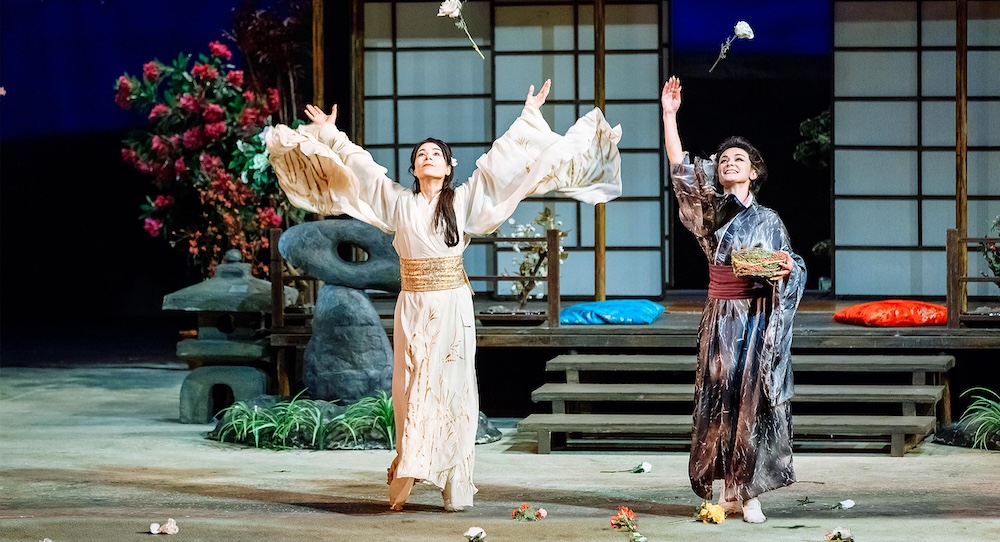
The following night, Puccini’s Madama Butterfly, sung in Italian with subtitles, opened with a very different flavour – an elaborately picturesque Japanese garden. An open-fronted house with decking area and stairs down into the blossom-filled garden, lanterns hanging, bamboo fences and even working water features which were audible at times depending what was happening on stage.
It was quite emotional, a few moments in, to a swell in the emotive music, as Cio-Cio-San Butterfly entered serenely under a parasol, with children and women following behind her. Suzuki, her maid – Yelyzaveta Bielous – scattered petals before her, and we were introduced to a very visually expressive performer with incredible power and depth in her voice – Elena Dee – in her emotional representation of the geisha. The two women were very complimentary to one another on stage, showing a very loving rapport between them.
The tragic tale of Madama Butterfly’s marriage to American Lieutenant Pinkerton, who abandoned her, returning with his American wife and claiming the child Madama Butterfly had given birth to. There were some very heart-wrenching moments beautifully and unhurriedly performed. Pinkerton, played by Oleksii Srebnytskyi was powerful and suitably arrogant for his character. He was even booed at the end! Sharpless, the Consul accompanying Pinkerton, was also very convincing in his role. Given the unenvied role of telling the ever-patient, loving and naïve (which was quite endearing) Butterfly that her husband was not coming back to her, the Consul, performed by Iurie Gisca, shared a variety of emotions and expressions with the audience which was entertaining.
The majority of the production had just two or three characters on stage at one time, though there were some larger group scenes as well. I felt completely absorbed, plenty of time to feel the emotions, and the colourful set particularly brought great atmosphere. There was light and humour gently woven in – very much needed with this otherwise heavy subject. Suzuki understands first what is about to happen – Butterfly is asleep, and she takes it on herself to explain to Butterfly that the child will be taken away from her to America. Suzuki breaks down – it’s emotional to watch – as Butterfly tries to prize the truth from her.
In the end, the child (the child actor spent quite a lot of time looking bemused throughout Act II – I think they could feel the emotion through the music and song) is given an American flag and is blindfolded by his mother, who then stabs herself – appropriately done in silhouette. And of course, ironically, Pinkerton sings off stage – calling to her, coming back to her just a little too late. Thoroughly enjoyable evenings!
By Louise Ryrie of Dance Informa.