Sadler’s Wells Theatre, London.
2 July 2026.
“-320°F. Cold enough to freeze time.”
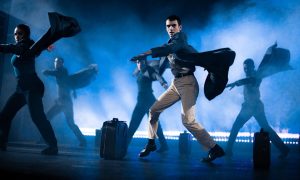
An open stage and an active opening scene is already underway as we enter the auditorium for Hideki Noda’s -320°F. Performers in black and navy tunics are at work on the grey/black landscape digging for fossils, sweeping, and some walking around with metal detectors.
The production is a fast-moving work of physical theatre, delivered in Japanese with English subtitles projected on a screen above. It’s very interesting to experience theatre in an unfamiliar language. Although well-presented, colourful and visual, the storyline is abstract and at times nonsensical. The script has a futuristic vision yet is oddly old-fashioned at the same time. Humour simplistic and farcical.
After a while the workers find bones – their own arms. Main character Help’s (played by Sadawo Abe) arm began to tremble, and the Professor Kyuri, played by Eri Fukatsu, says it is connecting to those bones which are being dug up. So, they begin to seek the Angel bone that connects to Help’s. “Bones carry humans forward,” said the professor.
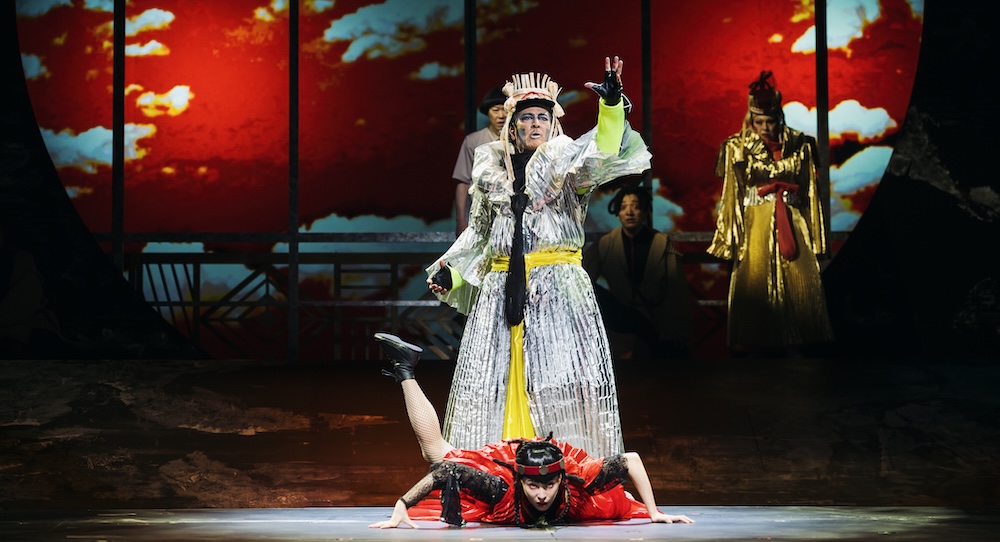
There are lots of short, concise little themes and scenes continually bubbling up, and fast changes of direction. There is a body of men and women playing laboratory mice who scurry fast and manically across the stage, following the Pied Piper. The show’s creator Hideki Noda stars as a god-like character who wants to be made eternally young. “My body is transitioning from firm, to infirm.” Noda states that; “Like all theatre, this will take your brain on a journey.”
Noda’s character is put into mixing flask and he emerges; “Young-ish. A mutation.”
Fast and slick changes of scene and onstage costume changes, are done with large sheets a lot of the time, either held by performers, or pulled across the overhead wire stretching the width of the stage. There are many scene changes and the backdrop which opened out into a circular entrance and exit formed the basis – with lighting changes – of a multitude of uses.
The press conference discussing Help’s trembling arm bone was effectively staged, with a long table across the platform at the back of the stage, and the rest of the company as the press on the stage floor on chairs facing up towards the press table. The set itself is well thought out.
The production used time travel to medieval and ancient times, and partway through one of Help’s memories a lively burst of dance movement occurs with performers using sign language to spell out words.
In general, actor’s voices are quite strained and continually loud, there is no rise and fall. The production kept up the same level of frantic energy throughout, which was quite draining. Impact could have been greater, by utilising different levels in the drama – some softer and slower moments to contrast with the high energy.
Although I’m not personally engaged by this production, the audience (there are a few early leavers) are attentive and chuckling along.
There’s plenty to be said for a one-act show, but at 2 hours and 20 minutes, without an interval, this felt too long for sustained concentration.
By Louise Ryrie of Dance Informa.