Sadler’s Wells East, London.
11 November 2026.
I arrive at Sadler’s Wells East Theatre ready for an ‘experience,’ as Rudi Cole, co-founder of HUMANHOOD, describes the company’s dance works. The stage for Vortex will become “the eye of the tornado” according to the pre-show writeup. HUMANHOOD creates non-narrative emotive pieces that leave audiences free to create their own story. It’s not a full theatre tonight, which is a shame. I enjoy full-length works very much, but I’m also keen for the total absorption you can abandon yourself to in a short one-act work such as tonight – 55 minutes in total. It is hoped that audiences will leave “feeling more connected to themselves, and to the invisible relationships around them.”
Here goes then! The auditorium darkens, and a familiar low hum fills the void. Predictably a few latecomers enter at this point…. and we plunge into darkness amid their whispers.
A small single spotlight widens centrally, until dancers standing in a circle around it are just visible. Motionless; we can feel the anticipation. Dancers wear conical hats, and baggy textured clothing in greys that appear lighter or darker depending on the lighting. Quite a slow start, with several changing spotlights illuminating a dancer in each; slow, tai chi-like movement. Faces are hidden by the hats, presumably purposely. Spotlights appear and disappear with different combinations of dancers within them, and then hats are removed and faces become visible.
As the slow, circular movement begins to build, along with a growing drumbeat accompanying the soundtrack, there is more dynamic and individual work, more floorwork. It’s eye-catching, and requires attention, in the shadowy light. Dancers are committed and expansive, and there is definitely the sensation of tornado in both the music and the corresponding, swirling choreography.
Dancers pulled away from, and then towards one another again; the fluidity of movement pleasing to watch and the lack of distinction between choreography for male and female dancers a very interesting concept. The dancer’s movement-related breath patterns can be heard over the soundscape which is reasonably loud, and has a repetitive, meditative feel to it as HUMANHOOD pieces often do.
There’s a great visual moment when all dancers slide into the same spotlight at the same time, and a clever effect where a lighting bar slides from top to downstage, sweeping over performers and then the audience. The drum-beat resembles rumbling thunder at times, and I’m imagining them rehearsing this continuous work where movement never ceases. Explosive rise and fall, layered levels and softer and more agitated moments, but it keeps moving.
Breathy, mystical voices join the soundscape, and I enjoyed being pulled into the mesmeric ambience as we moved into a calmer section. The piece as a whole is full of mystery, with definite links to and inspired by space. Julia Robert and Rudi Cole themselves dance on to the stage from opposite corners, moving through slowly rising dry ice toward one another.
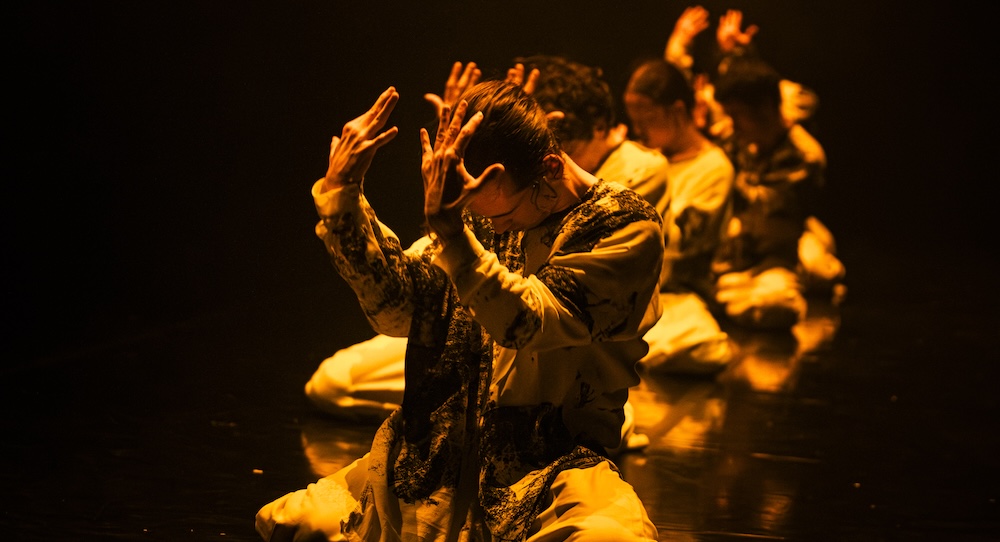
An hypnotic section next – six dancers sitting then kneeling in a row across the stage, moving in unison. A lot of knee-work! I’m drawn by the whole-body work, the all-encompassing deeply involved movement. And a little later, the freeing relaxed bouncing motion. Dancers – the original six plus Cole, moved to dance in warm spotlights across the front of the stage. They then dispersed into another growing sea of dry ice, which built rapidly, in movement and in sound, to a climax. The central spotlight decreased gradually, until – blackout.
I enjoyed it – and it can absolutely be described as an experience!
By Louise Ryrie of Dance Informa.