Sadler’s Wells, London.
25 May 2026.
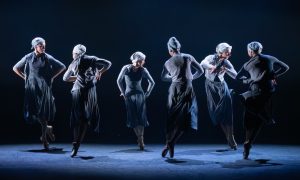
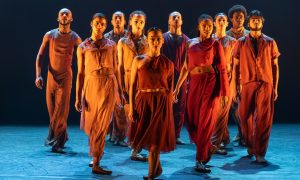
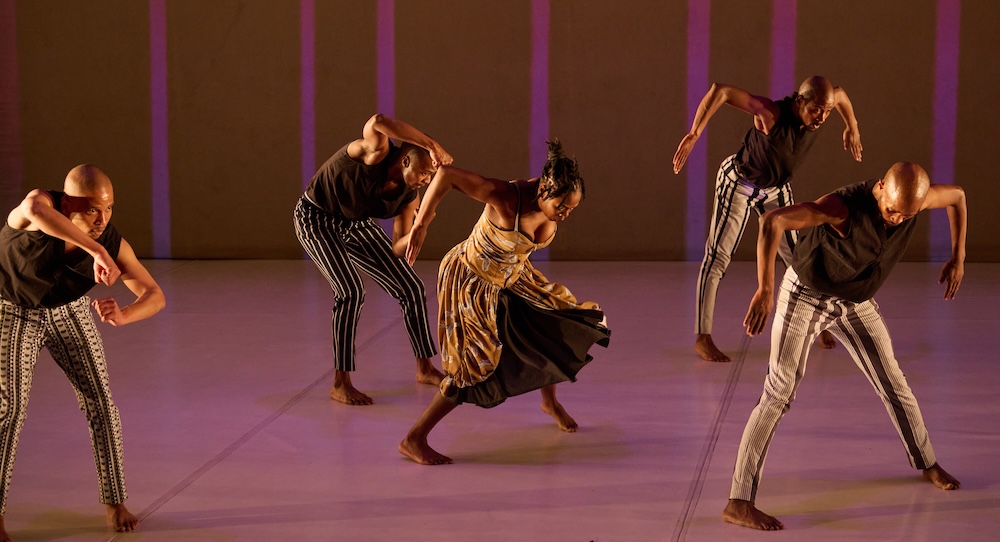
“To be or not to be, that is the question.” How else could you possibly open The Dance Factory’s rich piece of dance theatre based on Shakespeare’s Hamlet than with this most famous quote spoken by actor Aphiwe Dike. The barefoot community entered the stage for Dada Masilo’s HAMLET clapping enthusiastically. Their contemporary movement was so expansive and effective, infused with African choreography and infectious drumming rhythms. Full of immediate flavour that was sustained throughout – fast spins, dresses swirling, hips thrusts, thigh slapping and shimmeying.
I loved the occasional switch up between musical score and spoken word, though diction was quite unclear, and emotion received via passionate deliverance rather than hearing the actual text. At times, it felt ambiguous about which character was which, but we were never without atmosphere, or movement with intent.
South African choreographer Masilo is renowned for her reinterpretation of classics, and tonight, told through the eyes of Ophelia – danced passionately by Lehlohonolo Madise – who descends into madness when Hamlet accidentally kills her father, we are in fact treated to some of the intense complexities that make up the story of Hamlet, themes around relationships and betrayals.
The original score of this one-act fast-paced evening by Thuthuka Sibisi was hypnotic and energetic simultaneously. It built drama and danger, and its female vocals, built intensity and emotion.
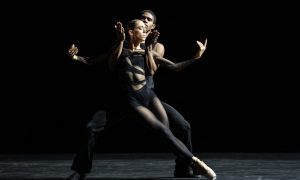
Llewellyn Mnguni both restaged the work and danced the role of Gertrude, Hamlet’s mother – a strikingly elegant figure. She had a particularly emotive scene when receiving the news of Hamlet’s father’s death and her cries were audible over the music, her collapse heavy, surrounded by those who tried but were powerless to help with the overwhelming emotion of grief. We were introduced to Ophelia in earthy-coloured dress, alone on the stage, moving sensuously and soon joined by Hamlet in black tie. They moved closely together, and opposite one another – lots of magnetic attraction which led to a faster, more insistent duet, which became violent and Ophelia was thrown rejected to the floor.
A simple backdrop of projected leaves on trees, gave way to vertical stripes that reflected onto the stage floor, and other subtle designs that unobtrusively set the scenes. The free, abandoned way this cast moved was very stirring and alongside the high-intensity drama were lighter moments, camaraderie and play between characters.
Back to drama, and Hamlet’s impulsive strangling of Polonius – David Maluleka – was very well-staged; Ophelia’s father was dragged onto the stage by Hamlet after accidentally overhearing a conversation between himself and his mother Gertrude. Although his death was expected, the sudden despicable and deliberate action was quite shocking.
The music rose unsettlingly to illustrate Ophelia’s unravelling, as she trembled, laughed and twitched, travelling through a variety of emotions. She wore a white gauzy gown and staggered holding a messy bouquet of wildflowers. She dropped them one at a time and lay herself upon them. She pushed with her feet until she slid backwards offstage.
The poisoned sword was then prepared, and Ophelia’s brother Laertes – danced by Thuso Lobeko, tussled together, using the whole stage. They exited still fighting and the mix-up of the poisoned goblet of wine began, but with a twist, as each dancer entered holding an identical goblet.
This was a hugely emotive ending, with high level energy and commitment throughout. They all drank from their goblets at the same time and all convulsed and collapsed to the floor as the lights turned a deep red. Hamlet entered the stage and centrally drank from his goblet. He, too, sank and joined the lifeless bodies on the ground as lights faded to blackout. Yet another simple and profound example by Shakespeare and here by Dada Masilo, of the futility of hatred and fighting. Will we ever learn?
By Louise Ryrie of Dance Informa.