Richmond Theatre, London.
1 July 2026.
“Strong young women the world can lean on!”
Emma Rice Company’s Malory Towers is gorgeously uplifting theatre that entertains from beginning to end, breathing life into a long-forgotten era of a simpler lifestyle, via Enid Blyton’s famous book series about the all-girls English boarding school, Malory Towers.
It’s heartwarming and heart-breaking at the same time to watch how the girls embrace one another openly for exactly who they are. There’s no mention or questioning of their images, or physical appearances. But there is plenty of discussion about each other’s characters and what they can do to better those!
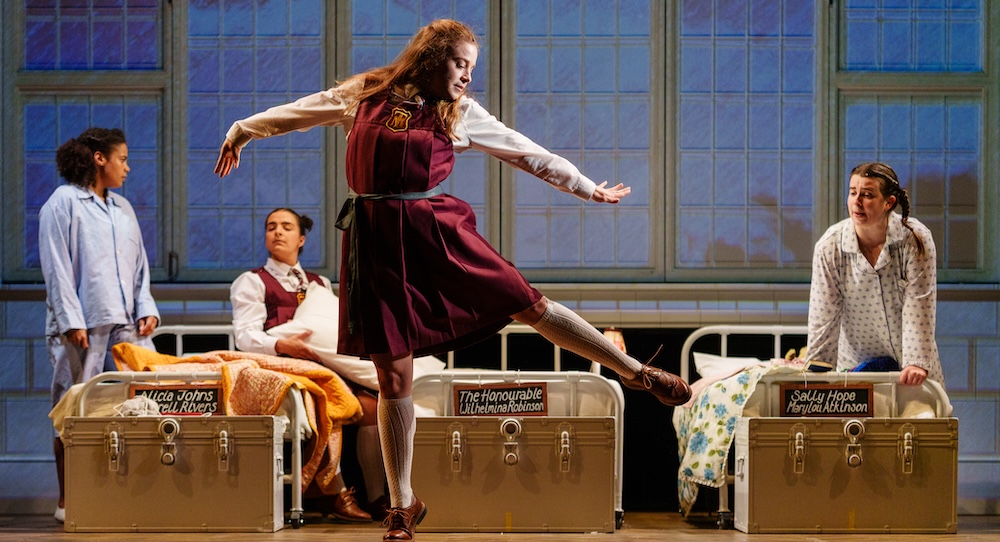
As the gentle show unfolds, with strong undercurrents of friendship and loyalty, each of the students has their backstory brought to the fore. The girls’ personalities bubble naturally with this skilful arrangement. Darrell, played by Robyn Sinclair, is every bit the hot-tempered character people will remember from the books. And Alicia – Molly Cheesley – tells innocently cheesy jokes constantly, to cover up her embarrassment at being kept behind a school year.
“What’s this?” she asks the others, breathing out heavily twice, “A pair of pants!”
The Honourable Wilhelmina – Zoё West – arrives on horseback in shirt, breeches, with cropped hair and a declaration that they were to be known as Bill. She was instantly accepted exactly as she was. Gwendoline, played with exquisite high dramatics by Anna Soden, is called out for her spiteful behaviour. It unfolds that she was reacting to a situation at home where she felt unwanted by her parents due to her father returning from the Second World War suffering from what would now be known as PSTD. He dies while Gwendoline is at Malory Towers and the girls gently help her pack to go home. She’s treated with love, despite having treated them all unkindly, and they sing; “You’re sugar, you’re spice, you’re everything nice,” to her.
There’s a little breaking of the fourth wall; at one point Gwendoline stalks away from the others and sits in the audience making new friends. There are fun, touching nods to Enid Blyton’s sometimes formal writing style; when the girls introduce themselves to each other on the train down to Cornwall, they do so with their full names, and the others turn to the audience and respond together similarly; “Hello, Irene Dupont!”
The girls push old-style school desks on to the stage, lift the lids and take out their work. There is a classic school song which they sing heartily. The Headteacher Miss Grayling is portrayed as a silhouette on the back scenery, and a serious kindly voice, provided by Dame Shelia Hancock. It works very well, leaving the focus on the students.
The set too has been cleverly thought out, with a backdrop of the inside white wall of an old-fashioned school hall, it’s white turrets visible on either corner. The centre of the wall opens to become many things – a window to the sea, a stage, the clifftop edge. Gymnasium climbing bars are either side. And underneath the central stage area, beds roll out to create the dormitory.
There are references to the pencil sketches that illustrated Enid Blyton’s stories; scratchy animated drawings are projected to show the rescue of Marylou – Eden Barrie – when she falls over the edge of the cliff. And puppets act out Darrell and the others rushing out that first morning at boarding school to jump off the cliff into the sea. Cleverly done and very entertaining even if you didn’t understand the references.
“Hush now Sally, hush now friend,” the girls sang a lullaby-style song to calm their friend Sally, played hysterically well by Bethany Wooding.
Irene Dupont, with pencils crisscrossed through her two buns, is played by an incredibly talented Stephanie Hockley who is also Musical Director. She has such a melodic voice. They all harmonise luminously together. Music runs behind the action as an almost permanent feature, if not singing and dancing, then Irene is lightly playing the piano behind the acting in a scene which discreetly added emotion and weight.
The sense of community and unity at the base of all their adventures, demonstrating natural forgiveness and kindness, created quite a poignant and nostalgic longing for a return of nicer, kinder times. There were very positive audience comments on the way out. A definite feel-good production.
By Louise Ryrie of Dance Informa.