Richmond Theatre, London.
9 and 10 April 2026.
A cancelled train meant missing Act I of Acosta Danza’s Carmen, throwing me straight in to the wild action of Act II:
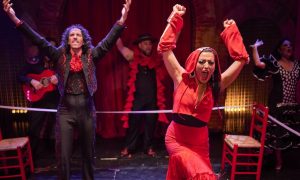
Low hung red lamps over tables and chairs and dancers leaning over them, beating tabletops rhythmically with their hands. Fast and furious dancing, clapping, cheering; on the tables, females releasing their tied-up hair. Bottles thrown between them, to the contagious and passionate score – Shchedrin’s orchestration of Bizet’s opera injected with Cuban music, and Escamillo pursuing Carmen by dancing for her as she sat on a chair enjoying the attention.
Which meant that by the time I came to view the whole production on the second night, it felt like watching in reverse (so interesting to be seated on the other side of the auditorium), and I thoroughly appreciated the opening scene, which was also the final scene, interrupted here by the imposing ‘Bull’ character, jumping down from his overview of the stage. It was an innovative way to introduce and tell the story, with the ‘Bull’ as the ‘master of ceremonies’ who arranged the characters into position – puppet-like – before they took off into this narrative work; an extremely emotional telling of the story of Carmen, through dramatic contemporary ballet, The pure sustained energy from the corps de ballet was extremely admirable and infectious throughout especially the way the flamenco rhythm and style was infiltrated through both the choreography and the story.
I also enjoyed the occasional pauses between the music. A breather from the intense action, they also served as little moments of interaction, often with humour, that added extra tangibility; the pouring of drinks and clinking of glasses. Flirtatious laughter and casual scene changes.
There were some briefly visited parts of the story such as Don José’s betrayal of his girl, which, if embellished could have provided more depth to the storyline, and overall length to the production, which was pretty short. It worked but it would have been good to have seen his character development a bit more, that lead to his jealous rage when he stabbed her.
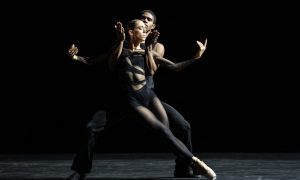
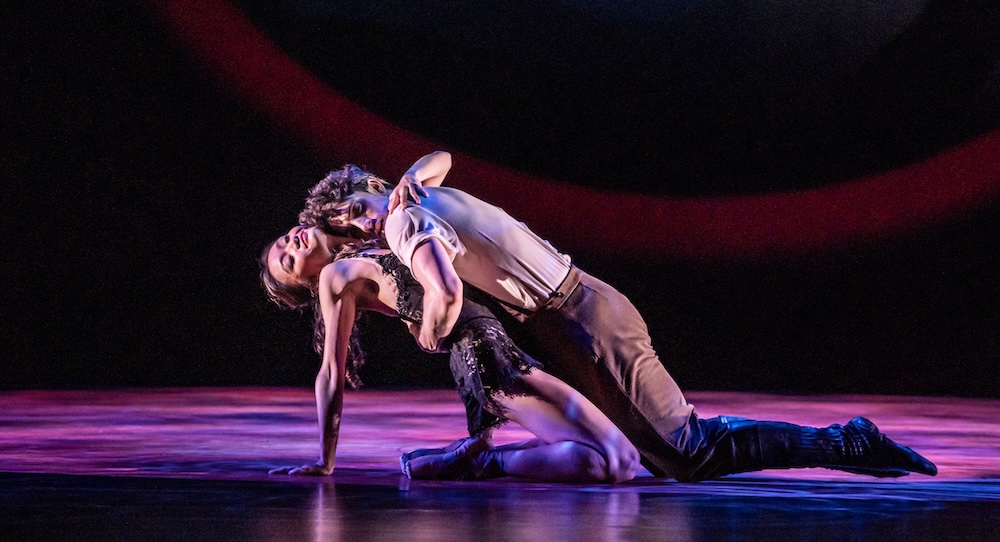
Some achingly beautiful partner work, both between Carmen (Adria Diaz/Thalia Cardin) and Don José (Alexander Arias/Aniel Pazos) and Carmen and Escamillo (Alejandro Silva/Frank Isaac). The themes, emotions and storytelling spoke so clearly through their movements. Some superb finer details such as Carmen trying to explain to Don José that she was in love with Escamillo, by showing the opening movements of the dance she had performed for Escamillo at the beginning of their affair. The final duet between Carmen and Don José, was very physical, frustration hugely evident for both their characters. He pleading with her, and she running at him pushing him over with her heel; challenging, almost daring him as he revealed his knife.
Carmen of the first evening I attended – Adria Diaz – was exceptional. Though both dancers I saw in the role could have used more expression in their faces, as we saw released in the relaxed final bows. The end was powerful. Carmen’s lifeless body was carried off by the Bull, over his shoulder, and Don José was immediately remorseful, dropping to his knees. A single rose was carelessly tossed down by Escamillo, demonstrating the same lack of sincere love he had for her, as she in turn had done to Don José, and he in turn to his previous lover. A serious message of loyalty and love in there, but strongly riding above it was one of entertainment, passion, and fabulous musicality. Very pleased I returned to witness the production in its entirety.
By Louise Ryrie of Dance Informa.