The Coronet Theatre, London.
26 February 2026.
Sci-fi meets contemporary dance in this cinematic showcase of Neon Dance’s Last and First Men.
Having never set foot in nor heard of The Coronet Theatre before this performance, it was the perfect venue. A restored Grade II-listed building that had lived many lives as a theatre, then cinema and now back as a cinema provided somewhat of a Tardis effect – entering from a modern street to an Aladdin’s cave of mismatching items and belongings. The eclectic decor, scattered throughout the foyer, lobby, labyrinth of hallways, and bar area, reminded me of sci-fi films where future colonies and outcasts find and archive lost and found artefacts, giving them a higher value than they had in their own era. It really fed into the idea of a show that explores time, age and history and will be a venue I check out again.
Set against a black-and-white, dystopian-film backdrop by Icelandic composer Jóhann Jóhannsson, with narration by Tilda Swinton, I had high hopes for this performance, which combined two of my passions: sci-fi and dance.
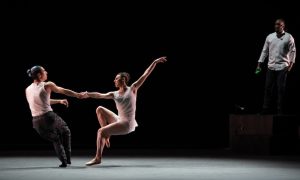
Concept and direction were by Adrienne Hart, who also choreographed the piece in collaboration with Makiko Aoyama and the trio of dancers, Fukiko Takase, Kelvin Kilonzo, and Aoi Nakamura. The 65-minute production explored the vastness of time and future possibilities, and showcased how evolution impacted society, with Homo sapiens communicating telepathically and on the brink of the end of civilization due to universal forces.
Despite my high hopes, this performance did not strike genre-blending gold for me, though its multimedia execution was to a high spec.
With that said, I envision this working well as an installation in a museum or gallery, much like the integration of dance in Wayne McGregor: Infinite Bodies at Somerset House in London – something that could be sampled to a viewer’s own level of need and want.
Last and First Men saw that the evolution of the human species had transcended conflict, religion, and the need to communicate through speech, with thought and telepathy as the main means of contact; however, the new, superior version had almost regressed in stature and physicality. The dancers effortlessly moved the stage as faun-like creatures, using finger placement and arm movements to resemble antennae, and, when matched with bent-leg walking and curvatures of the spine and upper body, they did seem inhuman.
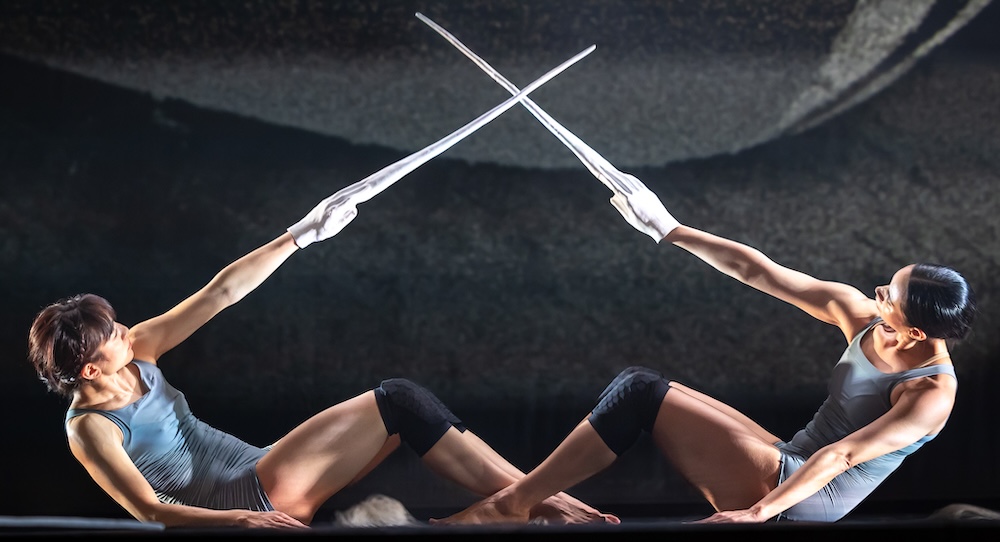
At times, large white claws were added to their hands, and space-age trainers that raised the dancers inches above their own heights were used to highlight aspects of the story and the timeline of human evolution.
A soundscape and immersive element were created by the movie and dance, with lighting by Nico De Rooji, costuming by Mikio Sakabe and Anna Rajcevic, and composition by Jóhann and Yair Elazar Glotman.
The blackbox style stage took on a 3D form, mirroring the vastness of the movie as it progressed, showing how devastating the sun could be as the planet on which the piece was set started to heat up. A film student would describe the Mise-en-scène to paint a realistic picture of a barren world with shots of monoliths and shapes, reminding me of futuristic scenes in Apple TV’s Foundation, being too big to fit the screen and the white wash making it hard at times to fully focus on the screen, mimicking as if you walked the bleached and scorched earth that this dancers inhabited.
A section that captivated me more was the introduction of Navigator characters. A subfaction of the remaining humans who were dissociated from the collective hive mind, tasked with exploration as astronauts, but returned to their homeland, fragmented from what they experienced. Reflected on stage by Kilonzo, who, when masked up, echoed both stillness and movements that highlighted the silo life described in Swinton’s narration.
The vastness of the film is the feeling I left the theatre with, not quite sure of what I had experienced, but appreciating that for some audience members they felt fully immersed and brought into the world.
By Jamie Body of Dance Informa.