Linbury Theatre, Royal Ballet and Opera, Covent Garden.
21 January 2025.
Where can dance take us next, is rooted in the work of Yorke Dance Project (YDP), who tonight presented Modern Milestones at the Linbury Theatre, Covent Garden. I really appreciated this excitingly diverse programme, with four short works in Act 1, followed by Christopher Bruce’s new commission Troubadour to celebrate his 80th birthday for Act 2.
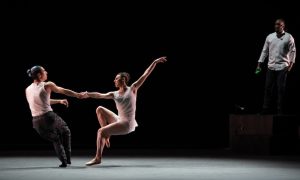
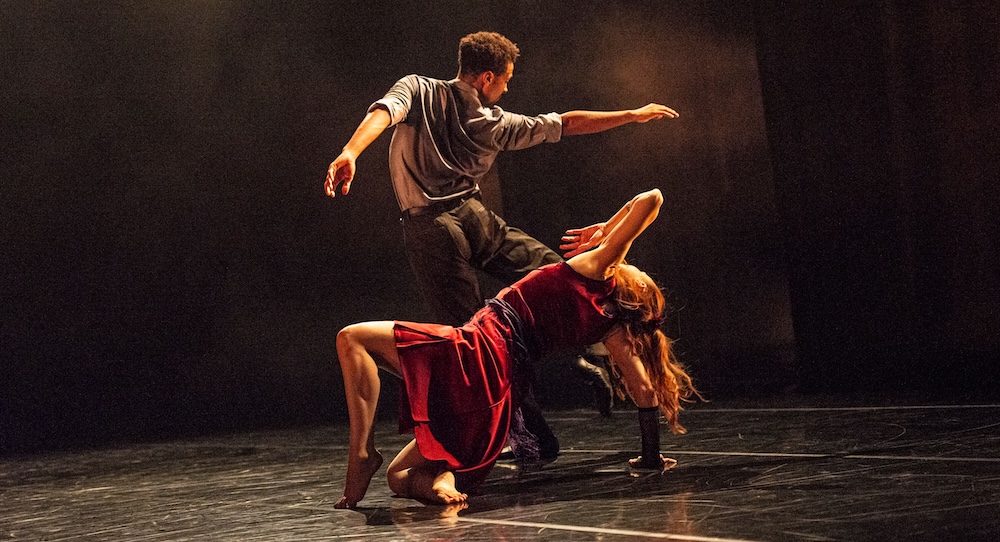
As part of YDP’s latest tour, this production celebrates past and present events in contemporary dance, including 100 years of Martha Graham’s Dance Company and the 100th birthday of Robert Cohan, whose 2015 work Lacrymosa was performed tonight by Elly Braund and Edd Mitton. Cohan revealed his starting point for the piece was about the loss and return of a loved one. Specifically, Jesus returning to Mary his mother, after leaving home to embark upon his ministry. A wonderfully intimate and layered relational subject matter offering audience connection on several levels. Braund, in a simple black dress, and Mitton, in black vest top and trousers, began facing one another across the stage in a silence I hardly noticed was there. I appreciated the sensitivity and sensuality of their touch and hold of one another – her gentle hand on his chest. Getting to know one another again, via satisfying, opposing elements of freeze and flow with sudden unexpected obscure lines and shapes. They moved towards, but away from each other, rebounding; one communicating and the other listening and responding. Some beautiful slow turns, unhurried lifts with soft landings. Their mutual reverent respect of one another very apparent. Emotionally beautiful to experience.
Deep Song, a 1937 solo by Martha Graham, opened the programme tonight. Danced by Ellie Ferguson, I was close enough to the stage to hear her breath as she began with a deep contraction ahead of the music. She moved in expressive response to the pain and anguish of the Spanish Civil War, with an effective mix of fluidity and sharpness; strong eyeline and expressions to narrate. Although the dancer is female, she is not intended to represent a Spanish woman, but “presents the torture of mind and body experienced by all people who feel what the Spanish people have faced.”
Her vertically black and white striped fitted dress that flared below the hip, was eye-catching and I felt there were many unspoken emotions in the choreography, for example when she laid coffin-like under a low white bench, which was also used to sit on, lie, fall onto or roll through. Simple and powerful imagery.
The curtain was closed in between each work this evening, which made sense for dancers preparing for the next piece, but as an audience member I often find it spell-breaking. In the darkness though, talking voices rose, entertainingly disorientating, and building to a thud of silence as four dancers ran forward centrally and froze in a small rectangle of light.
CAST(X) began with a floating soundscape in the background and continuous voiceovers; “I haven’t done anything….What would you have done?….Don’t look at me like that!” Liam Francis has really created an intense and thoughtful piece. The choreography is bold and accusatory at the same time as protective and supportive. They are so close to the audience that at one point a low round kick just skimmed the head of someone in the front row! The small rectangle of light opened out, with vertical lights in a straight-edged arc beaming down. A story developed between them on stage with enough ambiguity for the audience to create their own narrative. A very freeing piece of theatre.
Kinaesonata, a UK premiere by Bella Lewitzky exploded with athleticism in fresh, angular and precise movement that responds to Piano Sonata No.1 Op. 22 by Ginastera. It’s not a restful piece! It’s jangling keyboard adventure spoke of exploration and unrest, and was energetically expressed by six dancers, three male and three female. They wore mismatching colourful tops and legs and delivered a continual supply of clean, sharp, stylised lines. Full of running jumps into freeze-holds, great elevation and attack, and with a pleasing sense of emotion-led movement whilst being free from narrative.
After the interval it was time for Troubadour’s London premiere performance and Bruce’s first new work in over a decade. It filled Act II with the very essence of a smoky bar scene with just a single bar table central at the back.
It really was a time to sit back, relax into the six-track easy-listening folk-style music and absorb this smooth, suave piece. There was plenty of humour in both Leonard Cohen’s words and music recorded live in concert in 2008, and in the interpreted movement of all eight dancers on stage. Perhaps a little abrupt on the song changeovers, perhaps that was intentional.
Some relaxed charismatic tap work in jazz shoes, and intricate and sensual duets that melted on and off the stage; some entrances via just a hand through the backcloth curtain. I enjoyed the musicality shown through sultry movements; I think I could have heard the music if there wasn’t any.
An enthusiastic audience applauded, followed by a perfect ending. The eight dancers turned to dance slowly with their partner, and the curtain took an even more relaxed journey to close in the centre, leaving one last memorable glimpse to take home.
By Louise Ryrie of Dance Informa.