Sadler’s Wells, London.
24 September 2026.
Act I: Symphony in Three Movements
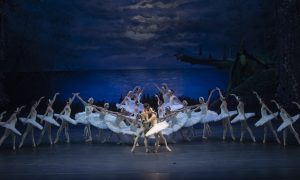
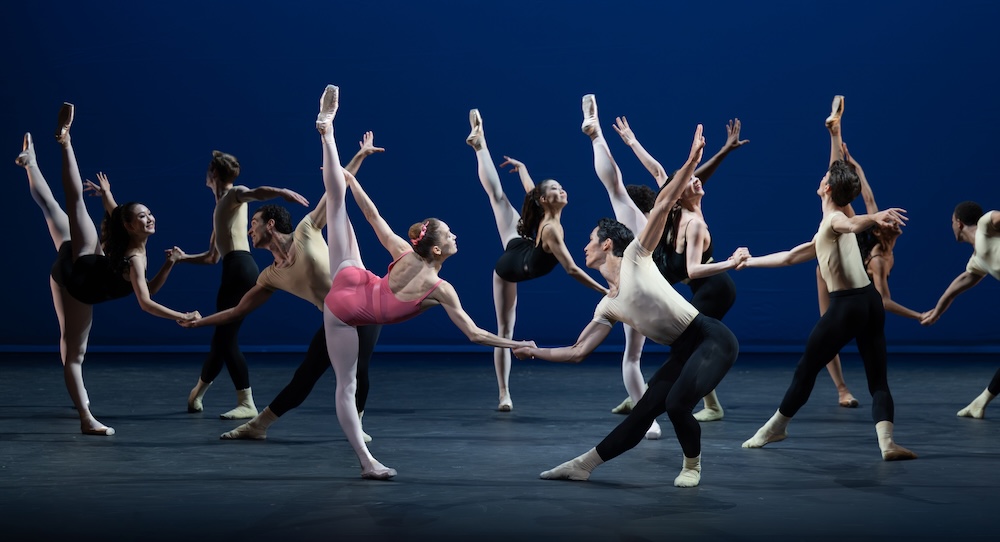
Intrigued by the title Rhythm Riot and what that meant for tonight’s triple bill by English National Ballet, the curtain opened on Act I and female dancers in leotards in a bold, striking diagonal line introduced the equally bold and striking 1972 Balanchine work to Stravinsky’s vigorous and variety-filled music.
It’s worth knowing Balanchine’s repetition through movement is intentional, to match the repetition in the musical score, as there was a lot of it. It was a great opening number; it was bright, a busy stage filled with organisation and direction. Fabulously energetic technical work, each of the three groups having their own patterns and rhythms whilst sharing the space.
I enjoyed it for its clear stylistic and athletic presentation; some quirky playful shapes and nicely contrasting moments where sharp and angular melted into smooth control. An unusual finish – dancers already in their final positions, still as the music continued to play and the curtain began to lower.
A good opening to the evening with this short work, spoiled I felt with a lengthy interval that halted immersion for the audience.
Act II: Bow Out
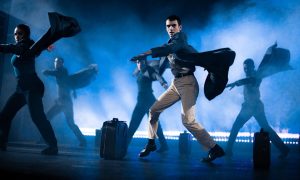
A world premiere by Micaela Taylor, who wanted to explore bravery and the ability to step out of the comfort zone. Bow Out began in an exciting uplifting way, male and female dancers both dressed in tails. Great use of the staging as the choreography filled, filtered out and filled the space again. It would have been great to see some tap, as well as hearing it on the soundtrack and mimicked on stage. Unique choreographic inspiration; from “Jumpin’ Jive” by the Nicholas Brothers and a definite highlight was the spirited Lindyhop section, infectious rhythms that really benefitted from the atmosphere of a live orchestra.
This number was at its best in its lively, quirky segments. It seemed a shame to sink into a serious heavy atmosphere after the first half of the dance had given such joy. I did like the additional power the dancers brought to the piece when they joined their voices to their expression, and a strong ending – all dancers on stage gave a single clap signalling lights out.
Act III: Auguries of Innocence
Another world premiere and atmospheric choreography from Jae Man Joo, inspired by William Blake’s poem of the same name, though it gave the lasting impression that it was possible to draw so much more from a poem of such depth, especially in varying the mood throughout.
There’s a continual feeling of danger, darkness and warning, through shadowy murky staging and lighting on stage, slow deliberate movement and atmospheric music that told a narrative all by itself.
There was a lot of frantic angst on stage, a feeling of anguish as dancers in black loose clothing moved, distractedly and purposefully at the same time. I liked how Sangeun Lee as the Weaver of Souls, took a lunge forward, her mouth wide open as though the extended note played was her call. She opened the piece, picturesque, in a backbend facing the audience as the curtain rose.
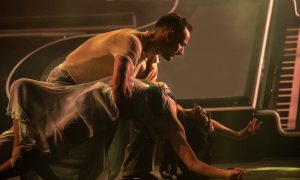
The drum section held a lot of promise – it felt tribal and as though the dancers were about to let go as crescendo and intensity built, but it never quite happened. Dark layers were stripped away, and dancers returned to the stage in nude leotards, evoking an Adam and Eve setting. Dancers mainly worked in pairs, and the orchestral strings were particularly moving here.
Lee was quite mesmerising in her role. She walked slowly with presence about and across the front of the stage, her black dress now with a long flowing train behind her. She turned and the dress coiled round her. She seemed perfectly cast in this emotional, almost ethereal role which almost felt like a farewell.
A very solemn end to a heavy piece, with dancers wrapped around one another in a still frame at the front of the stage, the Weaver (Lee) walking slowly off as darkness and the curtain descended.
Overall, really interesting to see the importance of rhythm running through all three pieces, and interpreted differently in each; very popular with the audience this evening on opening night.
By Louise Ryrie of Dance Informa.