Leading Japanese entertainment company Shochiku and globally-recognised arts agency Askonas Holt announce KABUKI, a triptych of three classic kabuki pieces which will be presented at Sadler’s Wells Theatre from 30 – 31 January 2027. This production marks the return of one of Japan’s most revered artforms to London after an absence of 17 years, and comes at a time of heightened audience interest in kabuki following the international success of the feature film Kokuho.
Dating from the early 17th century, kabuki is an all-male traditional Japanese theatrical art form, marrying music, dance and acting. Its vast repertoire ranges from historical pieces that date back hundreds of years to new theatrical experiences. The art form was officially proclaimed a Masterpiece of the Oral and Intangible Heritage of Humanity by UNESCO in 2005.
This production will mark the international stage debuts of Ichikawa Somegorō VIII and Onoe Tatsunosuke III, two of the most highly anticipated stars of the next generation of kabuki performers. Both Ichikawa Somegorō VIII and Onoe Tatsunosuke III come from a long lineage of renowned and highly respected kabuki performers. This presentation, produced by Shochiku, is the 11th kabuki production in London and the 8th kabuki production at Sadler’s Wells Theatre.
KABUKI will be made up of three dance pieces: Fuji Musume (藤娘) – The Wisteria Maiden; Yuki no Shakkyō (雪の石橋) – The Snowbound Stone Bridge – A Lion Dance; and Meoto Dōjōji (男女道成寺) – A Man and Woman at Dōjōji Temple.
In Fuji Musume, Tatsunosuke portrays the Wisteria Maiden, a spirit who takes the form of a young woman and dances of her unrequited love. The work draws on the imagery of Ōtsu-e folk paintings, in which the Wisteria Maiden was a popular figure associated with good fortune in marriage.
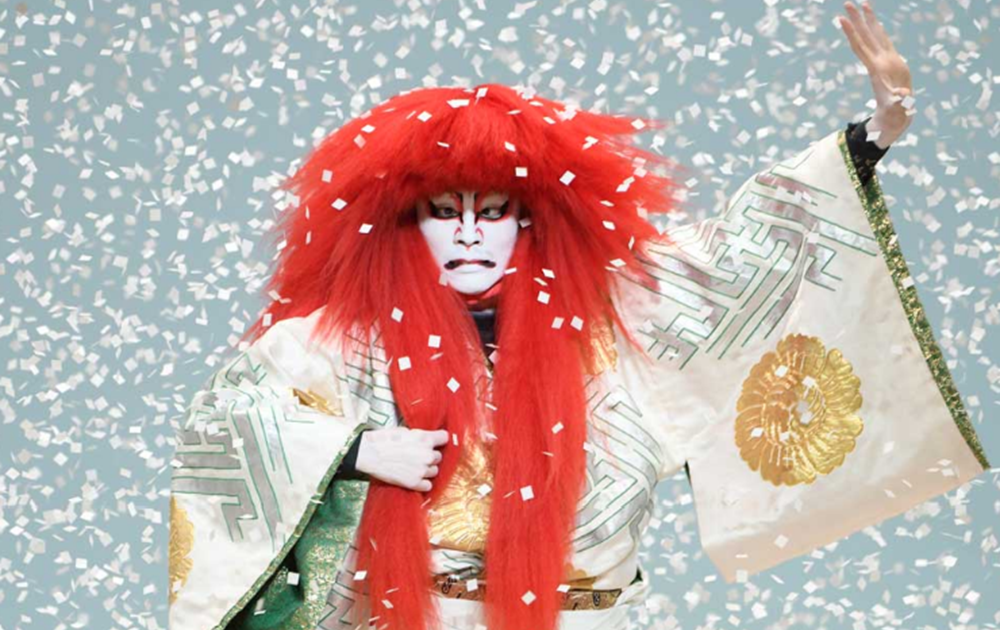
Somegorō performs Yuki no Shakkyō, a lion dance closely based on the classical nō play of the same name. The shishi, a mythical creature associated with the Buddhist bodhisattva Monju, displays his power through vigorous movements and the shaking of his mane.
The programme concludes with Meoto Dōjōji, a variation on one of kabuki’s best-known dances. Based on the legend of Dōjōji Temple, the work features two dancers who portray characters whose identities are gradually revealed, building to a climactic revelation.
Ichikawa Somegorō VIII said, “I am very grateful for the opportunity to convey the power of kabuki to people overseas together with Tatsunosuke, a fellow actor of my generation. Kabuki was born over 400 years ago, and has continued to the present day, absorbing the culture, sensibilities, and values of the people of each era. I believe it is like a mirror that reflects what Japanese people have accumulated over a long period of time. It is very important for people overseas to experience this unique beauty of Japan. At the same time, I also want Japanese people to know more about kabuki. I would be happy if we could not only share kabuki internationally, but also bring something of what we gain from that experience back to Japan.”
Onoe Tatsunosuke III said, “Kabuki is gaining popularity both domestically and internationally due to numerous new kabuki productions and online streaming, but I think there are still many theatregoers who have not yet actually seen it in person. The appeal of the art of kabuki lies in the atmosphere and excitement that can only be experienced live, so we are deeply grateful to have an opportunity to bring this experience overseas. We want to ensure that this growing interest is not simply a passing boom, but something that can be carried forward to the next generation. I look forward to audiences at Sadler’s Wells Theatre experiencing this art that has been passed down from generation to generation.”
For further information and to book tickets for KABUKI at Sadler’s Wells Theatre visit www.sadlerswells.com.