
London Coliseum, London.
28 January 2026.
Attending the relaxed performance of English National Opera’s HMS Pinafore brought with it added extras such as an introduction to Captain Corcoran – John Savournin – front of curtain before the show started, and to the conductor who then familiarised the audience with the different sections of the orchestra and even gave a short singing lesson in the interval.
I particularly enjoyed Act 1, which opened on a bright and busy stage, sailors in blue and white striped uniforms and straw boaters, working on deck. Cheerful banter and melodic songs with some simple yet effective choreography, as they began to present the classic love story between two couples of differing ranks of society which at the time would have made their love impossible.
The staging was impressive, a two-tiered deck of HMS Pinafore, which had a rotating central section, allowing us to view scenes inside the ship. The whole structure also rotated to enable scenes from the outside, such as when the Captain looked out to sea from the window.
Sitting next to a member of the Gilbert and Sullivan Society led to an interesting discussion about which parts of today’s performance were and were not part of the original, including the addition of the part of the Cabin Boy, played by Mel Giedroyc, and changes in some of the dances. I did enjoy the addition of a tap-dancing Captain Corcoran with a couple of his sailors and a hornpipe joined in by all the rest, at the beginning of Act II.
Giedroyc additionally played Aunt Melanie, and she had many comedic moments in both roles that fitted in subtly — for example, when Ralph alluded to feeling suicidal because he thought his love was not returned by Josephine, he was singing whilst standing on a barrel and a noose was lowered from the flies. Aunt Melanie stepped forward and nonchalantly passed him the noose. A little later as Josephine returned to the stage to declare her love for Ralph, Aunt Melanie got the noose caught on her foot and a dummy model dressed as her was hoisted up by the ankle and tossed out to sea!
In parts, though, the comedy was taken a step too far into pantomime, which spoilt and detracted I felt from the skill and professionalism of the cast and production. For example, Giedroyc and Savournin broke character a number of times and spoke to each other with their real names. Giedroyc also lay on a skateboard and pretended to swim across the stage whilst the Captain and Buttercup were in a rowing boat together. Whilst at this scene, an odd partnership was developed between these two characters, who had an unfortunate distinct lack of chemistry between them.
There were also a few times that singing felt too quiet or unclear, particularly when performers were deeper in on the stage. Subtitles were useful, although due to a high proscenium arch, this meant they were posted a long way above the action on stage.
The theme running loosely through that ‘love levels all ranks’ was a great message to send out, still relevant today, and of course intentionally misunderstood playfully on stage. For example, Sir Joseph, played by Neal Davis, was lined up as Josephine’s suitor. He complained to the Captain that she was not responsive to any of his advances. The Captain replied, knowing his daughter loved another, suggesting she felt inferior to Sir Joseph’s superior rank. Eleanor Sanderson Nash was bright and strong in her portrayal as Josephine. She deliberately misunderstood Sir Joseph’s subsequent assurance that ‘love levels all ranks’ and looking out to the audience, shared with them her intention to pursue her love, Ralph.
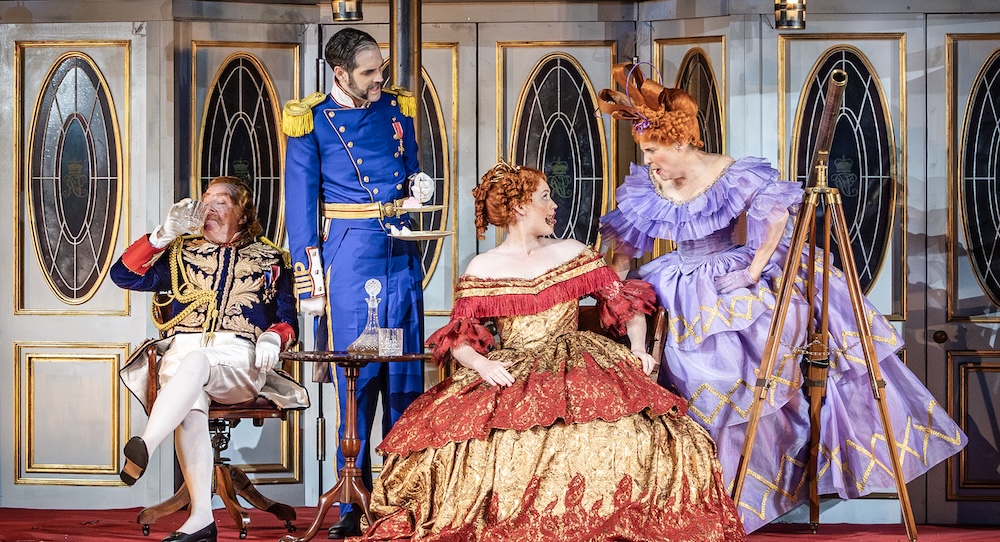
Act II was very colourful, with ladies all in different coloured elaborate period gowns. An exciting and visually impressive stage especially when the whole cast danced and sang together.
At the end, though, the storyline fell a little flat, despite its twist revealing a mix-up of Corcoran and Ralph when they were infants. The Captain accepted his lowly birth and dramatic change in status far too calmly, stepping forward jauntily in a common sailor’s uniform, and finally accepting Buttercup’s advances. The odd mix up meant the Captain and Ralph would have been the same age, meaning Josephine married someone of her father’s age. It made for a positive ending to the production, though, with happy couples all around.
Overall, a well-presented, light-hearted and entertaining afternoon at the Opera, which would have served extremely well as a first introduction to opera for anybody there for the first time.
By Louise Ryrie of Dance Informa.