Richmond Theatre, London.
4 March 2026.
“The urge to kill someone – we all have that!”
Based on the novel by James M. Cain and adapted for the stage by Tom Holloway and presented by Trafalgar Theatre Productions, Double Indemnity’s open stage as we entered the auditorium gave me time to appreciate the set’s angled walls and tall ladder-like structure designed by Ti Green. It gave the stage mysterious height and depth, great for characters coming in and out of the shadows. It also lent itself well to fast scene changes often taking place behind Huff breaking the fourth wall to speak frequently to the audience. For example, “I had forgotten to remember the intelligence of others!” when he came under heat following the murder of Mr Nirdlinger.
Lighting designer Joshua Gadsby excelled in creating atmospheric tension in every scene; side lighting through window slats, which striped across the opposite wall, and corner footlights casting huge shadows. Set and music had an effective connection; there was often tense underlying music, a drone-like hum or heartbeat thudding without really realizing it was there.
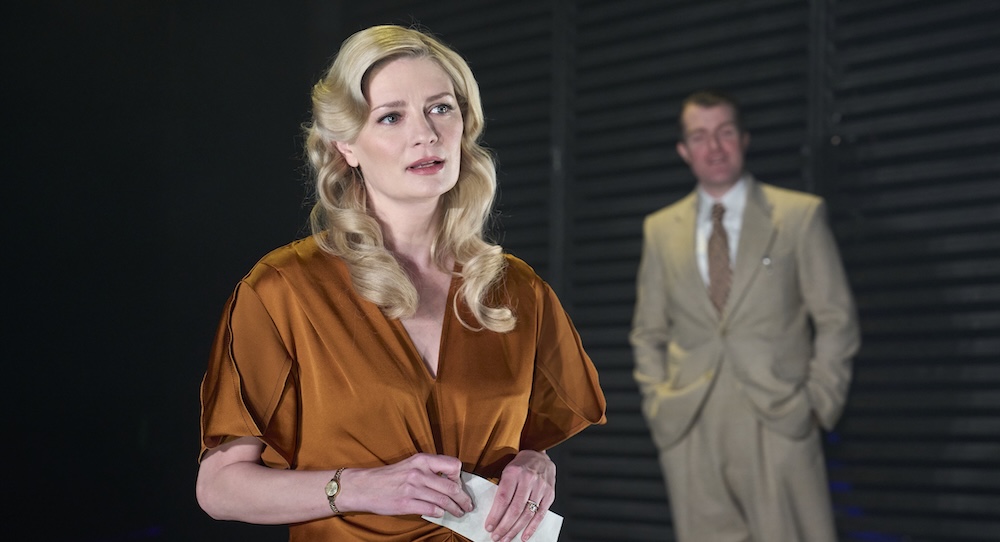
Mischa Barton, as leading lady Phyllis Nirdlinger, was not the seductress I was expecting. First on stage barefoot in a long burnt-orange dress in her home as she made her acquaintance with Walter Huff, (Ciarán Owens) her body language was quite soft and even stooped, which for me didn’t match with the calculated character that would be revealed throughout the play. Martin Marquez playing Keyes, was probably most convincing in his role at the Insurance company, though I worried for his blood pressure a lot of the time – a lot of tension and sudden bursts of shouting!
I enjoyed seeing Oliver Ryan in multiple roles as it provided light humour, particularly when he was playing angry and pompous Mr Nirdlinger – though he could have used stronger posture too – and ended up murdered by meticulous planning by Huff in the car driven by Phyliss. Yet in the next scene, Ryan appeared as a different character – Jackson – in the same train carriage as Huff (dressed as Mr Nirdlinger!) who was trying to stage Mr Nirdlinger’s death so he and Phyliss could claim and share insurance money on a policy.
As with many too good to be true plots, things did not go according to plan, but humour brought many highlights in this clever script – so important in an otherwise heavy subject matter! There was a fun recurring theme of staring into other’s eyes to read their intentions. Huff was told at different stages that his eyes were small, sad, steady….
I also enjoyed the tension-building movement as Huff, Keys and Mr Norton strode from office to office downing whisky and worrying about the potential insurance payout and how to avoid it. Or rather, Keys and Mr Norton came up with strategies, while Huff watched from the corner of the room in a state of quietly rising panic. Details began to emerge, particularly about Phyliss, that he had not previously known and perhaps we wondered if he might give himself away, especially when Mr Nirdlinger’s daughter questioned his stiff and hurt hands more than once.
The plot both tightened and unravelled equally towards the end, in this play I’d describe as the opposite of a murder mystery. The murder is carried out before us and we are privy to all the complicated details. The question for the audience is not who-dunnit, but will they get away with it, and how.
I was just at the point of thinking that there was only one real way out of the mess they’d created, when a final shot rang out and a blackout signalled the end.
Very entertaining evening.
By Louise Ryrie of Dance Informa.