
Sadler’s Wells Theatre, London.
5 March 2026.
I’d start by saying it was essential to have knowledge of the intricate storyline before watching the extraordinary full-length contemporary ballet creation of Scottish Ballet’s Mary, Queen of Scots. And I’d follow, confirming that this whole work from start to finish was incredibly detailed, absorbing, thoroughly well thought out, and absolutely stunning to watch.
“If there was a subtitle, it’s ‘Mary Queen of Scots – a non-historical ballet’!”
Choreographer and co-creator Sophie Laplane explained there were elements of imaginary worlds within the historical narrative, and that she wanted audiences to feel for both queens rather than think one was bad, and one good.
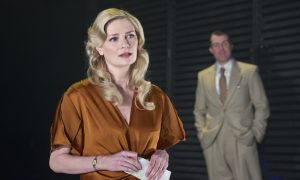
We see older Elizabeth, played by Charlotta Öfverholm, tell the story through her eyes on her last day on earth. Her aged memory is unreliable which offered huge artistic license to develop the storyline creatively. Elizabeth opened the production humming and dancing in a spotlight, dressed in undergarments and minus her wig. She was utterly engrossed in her memories as they floated in and out of her mind, and as an artist Öfverholm was so open, bringing us all with her into Elizabeth’s inner world of turmoil and pain.
A consistent, seamless flow of interwoven scenes – changes done by dancers, utilised nine large double-sided wardrobes on castors as entrances, exits, and even laid down to create moving platforms, particularly effective when Mary, stunningly danced by Roseanna Leney and younger Elizabeth, with great strength by Harvey Littlefield, glided past each other on them, leading their parallel lives.
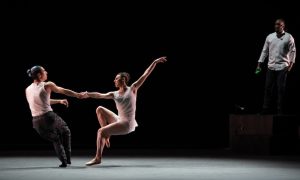
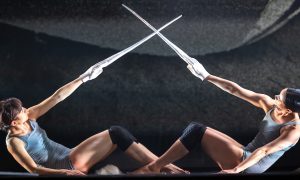
As the two queens never met in real life, it was very poignant when older Elizabeth stood arms outstretched holding a letter in each hand, written by Mary and younger Elizabeth to each other. They swiftly collected the opposite letter without eye contact. It might have been good to have seen this journalled relationship explored further. However, a beautiful idea emerged. Proxy Mary and proxy Elizabeth, dressed in nude dance briefs and tops, stepped from behind their namesakes and danced soulfully together. Maybe they explored what a relationship could have looked like if Mary and Elizabeth had been able to meet and support each other.
The musical score, created by Mikael Karlsson and Michael P Atkinson perfectly matched the onstage action. From light-hearted folk rhythms to dramatic and heart-wrenching melodies, each character and country had their own themes and there were so many stand-out moments.
Madeline Squire as Catherin de Medici – the Dauphin’s mother, entered encircled by a wide frame on castors representing period dress of the time. It served as a playful climbing frame for the childish early romantic play between Mary and the Dauphin. Walsingham, Elizabeth’s chief spy, danced by Thomas Edwards thrilled with a fantastic slide exit under a low raised wall across the back. He led the spies, who swarmed like birds of prey, slithering out of wardrobes, and shadows, eerie eyes on Mary and reporting everything back to Elizabeth via Walsingham.
And later, amid a passionate duet between Mary and Darnley – who dragged her screaming by the hair, accusing her of infidelity and leaving her crumpled on the floor – a spine-tingling moment arose when Mary stood and regained her power. The shadow work that followed on the back wall was unexpected and thrilling. Extensions of Mary, in the form of female dancers in dance nudes stood in front of Leney, and they all extended sharp elbows scorpion-like, casting a huge dominating shadow. Mary extended an arm and flicked Darnley away. As he met a murderous death, in a devastating scene, Mary gave birth to her son, James:
Represented here, entirely acceptably by a white balloon. The Jester, danced by Kayla-Maree Tarantolo, selected it from a cupboard of balloons and wrote ‘James’ across it. The Jester, who represented Death, followed older Elizabeth around in a quirky jolly way, time travelling with ease and biding her time.
Older Elizabeth desperately tried to share in the scene, having never experienced motherhood herself, and she took another balloon from the cupboard and imitated Mary’s actions with her newborn son.
Younger Elizabeth appeared on stilts in one majestic scene. Her court moved on their knees before her as she strode, physically superior above them. Perhaps this powerful demonstration of her authority separated her so much from them all, they couldn’t see the anxiety and worry that lurked beneath her surface. When Elizabeth had to sign the death warrant for Mary, she repeatedly pulled away in turmoil, and even older-Elizabeth who swarmed among them, forcefully tried to push her hand away. It was emotional watching older Elizabeth’s reactions as she tried to alter or intervene with her memories. Perhaps it makes us think of what we might come to regret ourselves looking back over our lives.
And of course, the dramatic ending, the eventual execution of Mary, who was encased by a cage lowered slowly over her. She was supported by the four faithful Mary’s until the end. There was of course plenty of anticipation for the execution scene and Mary entered composedly in a long black cloak and hood. As the final few seconds burst in to blackout, it seemed certain that nobody would be forgetting about Mary Queen of Scots for a long time. Outstanding.
Scottish Ballet will present Mary, Queen of Scots at the Spoleto Festival USA in Charleston (May 28-30), and David H. Koch Theater at Lincoln Center in New York City (June 4-7). For more information, visit scottishballet.co.uk/whats-on/mary-queen-of-scots.
By Louise Ryrie of Dance Informa.