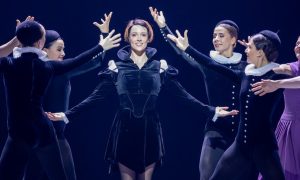

Sadler’s Wells Theatre, London.
12 March 2026.
The theatre was packed for Turn It Out with Tiler Peck & Friends, and the programme an interesting read. I noted with a little dread that there were two 20-minute intervals. I’m not a fan as an audience member, as it really stunts the flow and makes the whole evening feel disjointed.
Opening the evening was The Barre Project, Blake Works II, with choreography by William Forsythe and music by James Blake.
The curtain rose on Tiler Peck, facing the back in a metallic leotard and flat shoes. She’s attention grabbing from the very first second, immediately embodying the electronic score. But more than that, her passion for movement oozes out of her and it could almost be any music playing.
There’s a central cut out in the backdrop, across which runs a barre, attractively lit overhead. The piece is not what I’d envisaged from the title, but Peck and three male dancers – Lex Ishimoto, Brooklyn Mack and Roman Mejia — used the barre, mainly one at a time, as support or alignment, but they also moved away from it as well.
Peck is fluid, sharp, angular and expansive all at the same time. She appears in a different leotard each time she returns to the stage – with only a couple of minutes break each time. Her energy is the standout factor that she brings to the stage. In a red leotard with a short flicky skirt, she danced a ballroom style jazzy duet with one of the male dancers before flying off and returning in black. Breaking up the action was a projected video of hands on a barre, and some ‘hand-ography’.
The first interval followed this, a bit disruptive as I’d just started to sink into the production as a whole.
Thousandth Orange, choreographed by Tiler Peck, followed. A most attractive opening picture – male and female dancers in tights and leotards of different colours, entwined in a central pose, unwinding to the live piano – there’s also a grand piano, two violinists and a cellist on stage.
A lot of repetitive piano chords, pizzicato in the strings – quite an agitated piece. There was some very loving, partner orientated choreography – mainly male/female with the latter half feeling richer and more emotively involved with the music, composed by Caroline Shaw. It’s always enriching to have live music and dance together on the stage; it creates a very special relationship, though I felt the choreography was not particularly innovative and didn’t always pick up on the nuances of this intricate piece. The ending was in a similar clustered position as the start.
Swift Arrow followed, choreographed by Alonzo King, and kept the grand piano on stage in the top right corner. Peck in a navy leotard and Roman Mejia in navy shorts stood apart on stage to begin. There’s a rhythmical beat (recorded soundtrack) behind the live piano, and Peck began her signature way of moving. She’s incredibly expressive and leaves you in no doubt that she is exactly where she is meant to be – dancing.
She stands to one side while Mejia dances, then the beat disappeared and they moved together to the piano music; a tight duet – clasped hands and rapid movement wrapped around one another. It felt quite emotional and picked up some nice high and lowlights in the music.
Following another interval, Timespell – choreographed three ways by Tiler Peck, Michelle Dorrance and Jillian Meyers, along with collaboration and improvisation from dancers, began with a solo unaccompanied tap dancer in a spotlight. Sound came first, then the curtain – a nice touch. Other dancers walked on to stage – in soft shoes, but in the rhythm of the tap.
There were two vocalists on stage – Brinae Ali and Aaron Marcellus Sanders, singing live, a wordless (mostly) rippling chant creating quite a hypnotic stirring feel that dancers moved to, separately and together. It was impactful, though it’s unlikely it would have been possible to guess the style of music dancers were moving to as their choreography felt quite generic initially.
A duet followed, with Peck in a short white dress on pointe. Rich vocals, with a recorded soundtrack, gave it an earthy, soulful club feel. Hazy atmosphere and atmospherically lit. Others joined them onstage – with females on pointe – and the music built. A line of tap dancers entered from the side – a great section that collaborated satisfyingly with the vocals. This was followed by Peck and others on pointe, which had a smoky, seductive feel, and a ballet duet – two men, with two artists clapping and tapping rhythms as they danced. Very effective.
A bit of a dance-off grew between pointe and tap, though really it was more of a flourishing collaboration between them. It built towards the end with a gorgeous supportive mix of techniques, styles and disciplines enjoying the music and the dance together filling the entire stage. Very entertaining.
By Louise Ryrie of Dance Informa.